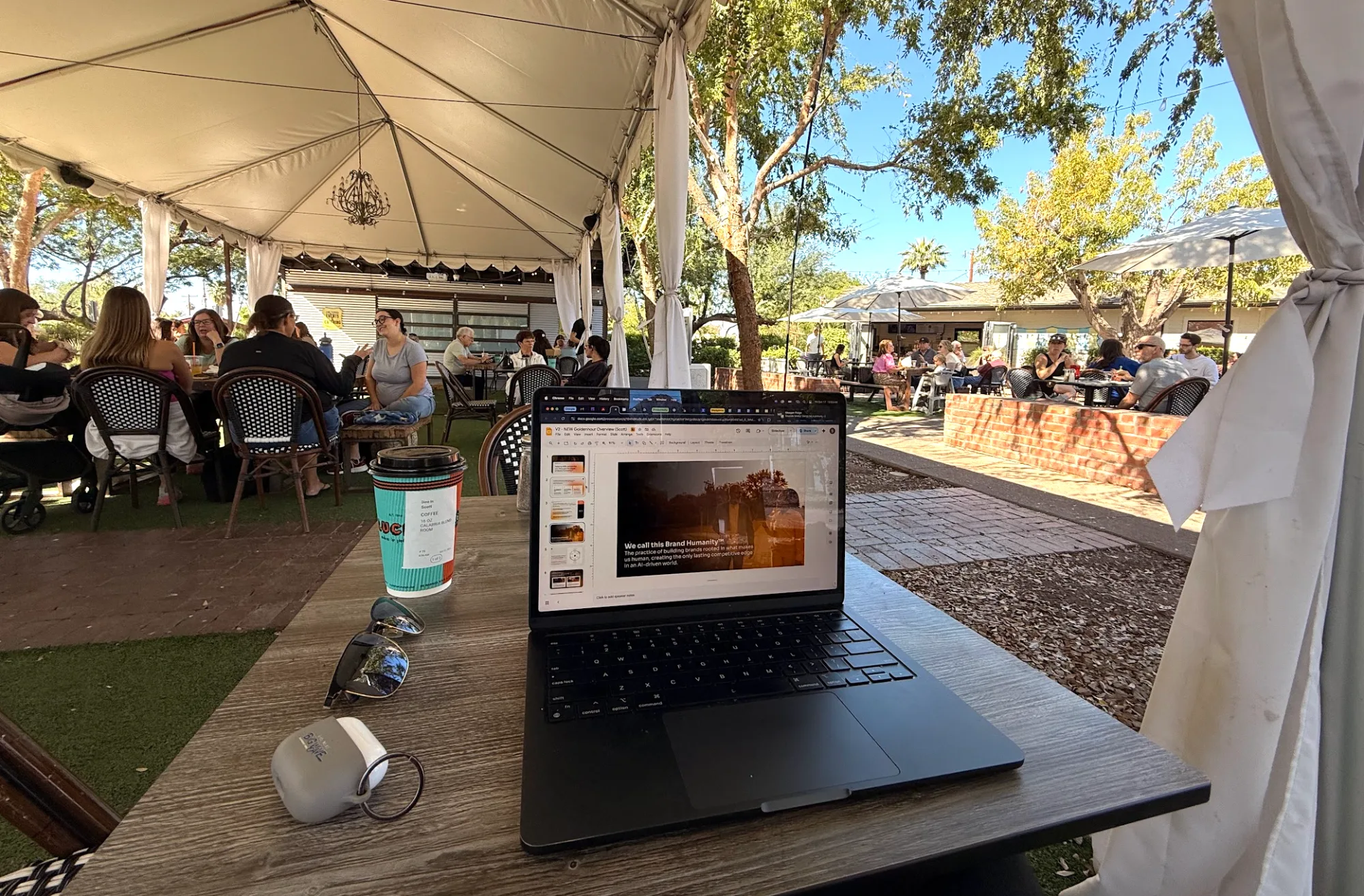
Brand Humanity started over coffee.
There was no offsite. No research brief. No naming workshop. No 47-slide strategy deck waiting for us when we sat down.
Anthony Kennada and I were doing what we have done a hundred times: talking about companies, marketing, technology, people, and whatever was keeping us up at night.
That day, it was AI.
We were talking about what happens when every company can suddenly create more. More content. More campaigns. More personalized messages. More analysis. More polished work, produced faster and cheaper than most of us could have imagined a few years ago.
Anthony had been developing a thesis about the brands that would win in that world. It was remarkably close to something I had been circling in my own head.
The companies that stand out in the age of AI will not simply be the ones that use AI best.
They will be the ones that remain the most human while they do it.
We started adding to each other’s thinking. Testing the edges. Asking what “human” actually meant when applied to a brand. Trying to turn a belief that felt true into something leaders and teams could actually use.
By the time the coffee was gone, we did not have the full framework.
But we had the beginning of Brand Humanity.
The question underneath the AI conversation
I love what AI makes possible.
I'm building an AI company. I use AI every day to research, think, write, challenge assumptions, build, create, and move faster than I ever could before. I do not believe the answer to AI is less AI.
But I do believe we need to become much more intentional about what we ask it to do.
Because AI is making competence abundant.
It can already create a decent first draft, a polished image, a useful analysis, a campaign plan, a sales sequence, a website, or a point of view that sounds suspiciously like every other point of view on LinkedIn.
That is progress. It is also a rising sea of sameness.
When everyone has access to similar intelligence, similar models, and nearly infinite production, the ability to make something is no longer enough to make it matter.
So the question Anthony and I kept coming back to was this:
What becomes more valuable when execution becomes abundant?
Our answer was humanity.
Judgment. Empathy. Emotion. Taste. Creativity. Trust. Conviction. Connection. Shared experience. The courage to make a choice that reveals who you actually are.
These are not decorative qualities to sprinkle onto the work after the machine is finished.
They are the source material.
That is why we define Brand Humanity as the practice of building brands rooted in what makes us human, and the humans who make them authentic.
It is not about making every brand softer, friendlier, funnier, or more sentimental. A human brand can be bold. Serious. Rebellious. Precise. Strange. Demanding.
It just has to be true.
And the truth cannot live only in the copy.
Brand is every interaction a company has with the world: how leaders lead, how employees are treated, how teams make decisions, how salespeople sell, how customers are supported, and how the company behaves when the script runs out.
The goal is not to appear human.
The goal is to behave humanly.
Before Brand Humanity, there was Human-First
This idea didn't appear from nowhere.
Long before Anthony and I gave it a name, he and I both had the privilege of living a version of it at Gainsight.
Nick Mehta called it Human-First.
Gainsight’s mission was to be living proof that you could win in business while being human-first. That was not language buried on a culture page. We talked about it constantly. We hired around it. Onboarded around it. Made decisions around it. Tried to show up for customers, teammates, families, and one another through it.
We did not always get it right. No company does. But it was real enough to shape the place—and the people who had the chance to be part of it.
Nick has explained that Human-First came from needing to express not only what Gainsight did, but how and why it did it. His point was disarmingly simple: employees, customers, competitors, and everyone around the business are human beings before they are business abstractions. (Stage 2 Capital)
He has also made the connection to technology clear: the goal of automation should be to remove administrative work so companies can create more meaningful human interaction, not eliminate it. (UserTesting’s Insights Unlocked)
And in a recent post about category creation, Nick brought the idea down to the smallest moments: noticing the person who looks lost at an event, the prospect whose child wanders into the Zoom, or the buyer who has quietly lost a job. People can tell whether you are treating them like humans because it helps the funnel—or because you actually care. (Nick’s post)
That is the inheritance inside Brand Humanity.
Human-First taught us that humanity and performance were never opposites. Brand Humanity carries that belief into the AI age and asks what it means for the way companies build brands, design go-to-market systems, create customer experiences, and divide work between humans and machines.
It is not simply marketing philosophy.
It is a way of building a company.
Turning a belief into a framework
“Be more human” sounds nice.
It is also almost useless as an operating instruction.
From the get-go, we knew Brand Humanity needed to be more than a phrase people agreed with and forgot. It needed structure. It needed tension. It needed a way to look at real work and make it better.
So we developed six Human Truths:
Authenticity: Is this rooted in something true, distinctive, and credible?
Emotion: What should a person feel, and why will that feeling matter?
Purpose: Do people understand why this matters and what they are building together?
Creativity: Does this demonstrate judgment, originality, and a recognizable point of view?
Connection: Does this create a relationship, or merely generate an interaction?
Belonging: Does this help people feel recognized, included, and part of something meaningful?
Not every piece of work needs to activate all six. In fact, trying to force all six into everything is a good way to create mush.
Strong work usually commits to two or three and earns them honestly.
A product launch may need purpose, emotion, and creativity. A customer community may depend on connection and belonging. A company narrative may live or die on authenticity. A difficult customer conversation may require no clever campaign at all—only empathy, accountability, and a real person willing to show up.
The framework helps identify the humanity gap: the distance between what a company wants people to experience and what its choices actually make them feel.
And increasingly, that gap is being shaped by AI.
The real question is not whether to use AI
I think we are wasting far too much time debating whether work should be human-made or AI-made.
That line is already blurry, and it will soon be meaningless.
The more useful question is: What role should AI play here?
Brand Humanity gives us four answers:
Automate repeatable work where consistency and speed matter more than human presence.
Augment human thinking, exploration, and execution while a person retains judgment.
Keep work human-led when taste, empathy, context, trust, or accountability determines the quality.
Protect the rare human-only moments where automation would make the experience less meaningful or simply false.
Formatting a set of assets? Automate it.
Synthesizing weeks of customer research? Let AI help.
Setting the company’s strategy, responding to a scared employee, apologizing to a customer, or telling someone their work changed your life?
Be very careful what you hand away.
The point is not to protect tasks because humans have always done them. Plenty of tasks should disappear.
The point is to protect meaning.
AI should give us more capacity to be human, not less reason to be.
Why Brand Humanity became the foundation of Duet
At first, Brand Humanity felt like a framework Anthony and I could put into the world and help other companies use.
Then I realized that I was building a company that needed it as much as anything or anyone.
Duet is a new kind of marketing workspace where human operators and AI agents work together from strategy through execution to deliver real go-to-market outcomes.
The company’s Marketing Brain holds the context that makes the work specific. Digital Twins and agents bring intelligence, pattern recognition, and execution capacity. Human operators bring craft, perspective, taste, empathy, and last-mile judgment.
Brand Humanity is the governing layer underneath that collaboration.
It helps us decide what the machine should do, what a person should own, and how both can work together without turning the brand into a faster version of everyone else.
But it also has to govern how we build Duet itself.
If we help customers create more human brands while building a company that treats employees as resources, customers as accounts, and experts as interchangeable inputs, then the framework is just performance.
I want Duet to be a company where people can do ambitious work without disappearing beneath it. Where AI creates room for curiosity, creativity, family, judgment, relationships, and the moments that make the work worth doing. Where the technology scales capacity without shrinking the human beings using it.
That is a much harder standard than putting “human” in the copy.
And that's good. It should be.
Three ways to put Brand Humanity to work
One of the risks with any philosophy is that it becomes something people nod at and never use.
So we have started building tools that move Brand Humanity from belief to behavior.
1. Start with the Brand Humanity page
The Brand Humanity page here on ScottSalkin.com is the clearest introduction to the philosophy, its origin, the six Human Truths, and the Human + AI role map.
Use it when you are trying to understand the idea, introduce it to a leadership team, start a conversation about what your brand should protect, or rethink the relationship between leadership, culture, go-to-market, and customer experience.
It is the place to begin with the why.
2. Bring real work to the Brand Humanity Lab
The Brand Humanity Lab is where the framework becomes practical.
You can bring it a campaign, website, launch, sales motion, customer experience, piece of content, event, community idea, or AI workflow. Dawn—Duet’s Brand Humanity agent—reviews the work through the six Human Truths and returns a Humanity Profile, the most consequential gap, the human moments worth protecting, a Human + AI role map, and practical moves to improve the work.
Use the Lab when something is already taking shape and you want to pressure-test it before it ships.
Not “Does this sound human enough?”
Better questions:
Is there anything true here that only we can say?
What should someone feel? And have we earned that feeling?
Are we creating a relationship or manufacturing an interaction?
Is AI helping the work? Or is it quietly flattening it?
Which moments will a person remember after everything else is gone?
The Lab is free to use and does not require an email. Bring something real. That is where the framework becomes useful.
3. Work with the Brand Humanity agent inside Duet
The Lab gives you a check. Inside Duet, Brand Humanity becomes part of the work itself.
We built a Brand Humanity agent that can be used at the beginning of a project to identify which Human Truths should shape the brief. Or bring it into the middle when the work is getting more polished but less distinct. Or use it before launch to find the humanity gap. Or when designing an AI workflow to decide what should be automated, augmented, human-led, or human-only.
And use it after the work is in market to learn.
Did the experience create trust? Did people participate? Did they remember it? Did the customer feel understood? Did the team feel connected to the purpose? Did efficiency improve at the cost of something we did not intend to lose?
The goal is not another approval gate.
It is a better conversation.
Brand Humanity is not a score
Humanity is contextual.
The right automated experience can still be deeply respectful because it saves someone time. The wrong human interaction can still be frustrating, performative, or manipulative. A playful brand is not inherently more human than a restrained one. A handwritten note means nothing if the company’s behavior contradicts it.
The tools are there to sharpen judgment, not replace it.
They help teams pause long enough to ask what kind of company they are becoming through the choices they make every day.
That is the part I keep thinking about.
Brand Humanity began as a conversation about which brands would win in the age of AI. But it's becoming a much bigger question about what winning should mean.
- Can we build faster without becoming careless?
- Can we scale relationships without pretending every automated interaction is personal?
- Can we create more without flooding the world with more things no one needs?
- Can we use AI to make people more capable, creative, and present—not merely more productive?
- Can we build a great company without asking the humans inside it to act less human in order to succeed?
I believe we can.
Gainsight showed many of us what it looked like to try.
We created Brand Humanity to carry that belief into this next era.
And now we are building Duet to make it operational.
Because the future is not humans or AI.
It is humans and AI working together, in harmony, each doing what they do best, to create something neither could create alone.
The more AI can do, the more humanity matters.
That's not a warning. It an opportunity.