My kids have caught me using AI.
“Ooooh,” they’ll say. “Are you cheating?”
They’re joking. Mostly. But the joke comes from somewhere.
It comes from classrooms where some students are still taught that using AI is inherently dishonest. From workplaces where people quietly open ChatGPT in a second window, then make sure no one is looking over their shoulder. From creative teams that use AI constantly but would rather not admit it. From a culture that has somehow made people feel embarrassed for learning how to work with the most consequential technology of their lifetime.
We have created a strange new shame: the fear of getting caught collaborating with a machine.
And I think we need to get over it.
Actually, I think we need to do more than get over it. We need to completely change how we think about it.
Using AI is not cheating. It is not the creative equivalent of copying someone else’s test. And it is not quite like using a calculator, either. A calculator helps you arrive at an answer. AI can challenge the question, expose what you haven’t considered, help you see around corners, and turn the fragments in your head into something other people can actually understand.
This is not a shortcut around thinking.
Used well, it is a new way of thinking.
The em dash panic
I once worked with an executive who told an entire company that em dashes were no longer allowed in anything an employee created.
The reason was obvious: ChatGPT uses a lot of them. So an em dash had become evidence. A tell. A tiny typographical crime scene suggesting that perhaps a machine had been involved.
If an employee used one, the work would be looked down upon.
Think about how absurd that is.
We were no longer judging the clarity of the idea, the quality of the argument, or whether the words moved someone to think or act. We were judging punctuation. We were so afraid of appearing artificial that we started making arbitrary rules about what human expression was allowed to look like.
For what it’s worth, I love em dashes. I used them long before ChatGPT existed. They sound like the way I think—a pause, a turn, a thought arriving before the last one has fully left.
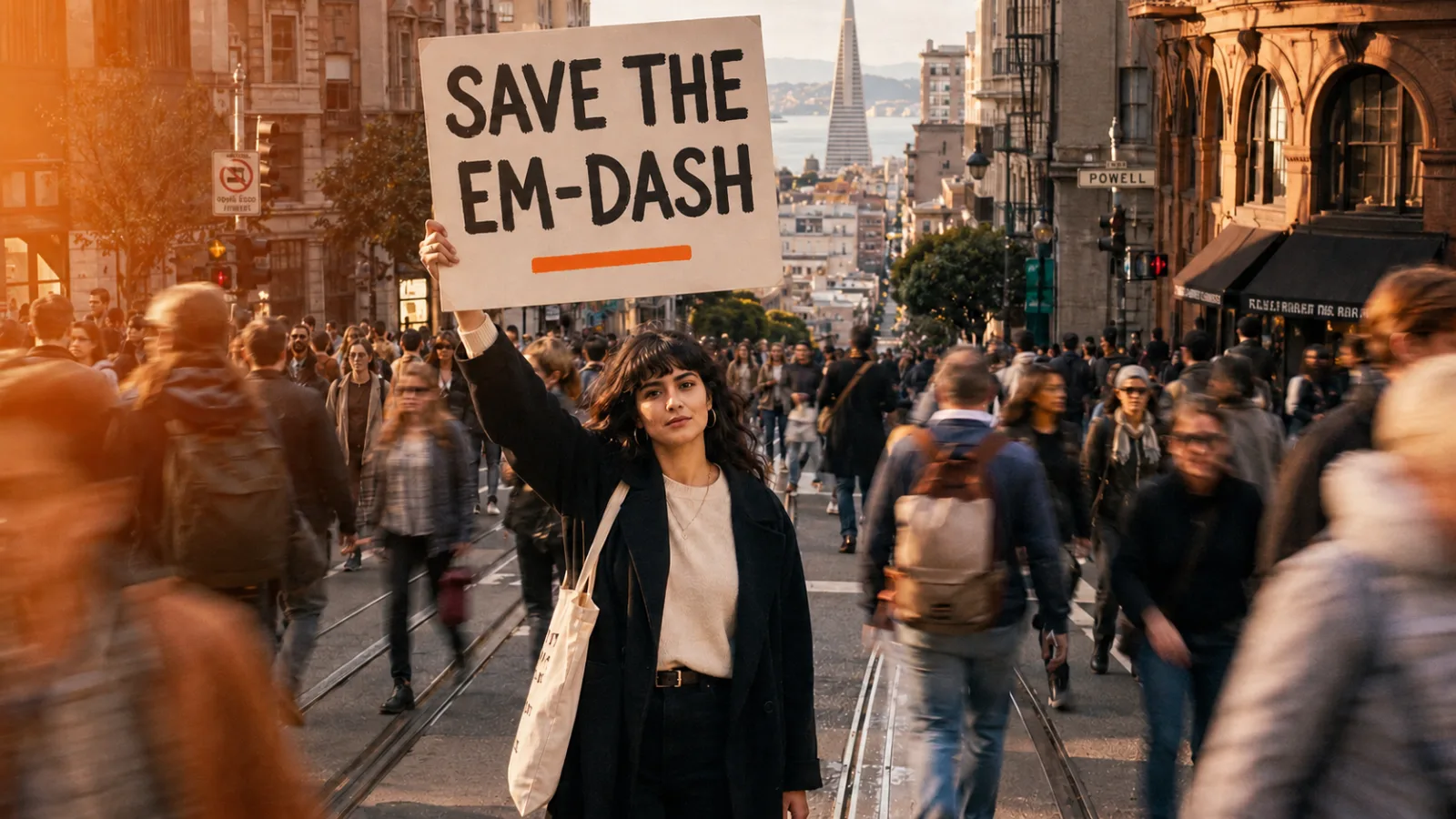
So I would like to start a movement.
Save the em dash.
But this is not really about punctuation.
It is about the shame we have attached to using AI, and the shallow ways we have started policing one another instead of learning how to use it well.
AI is not the enemy. Slop is.
Let’s acknowledge why the suspicion exists.
There is an extraordinary amount of AI slop in the world. We have all read the posts that say nothing, seen the images that feel eerily polished and completely empty, and opened the emails that manage to use our first name without recognizing our humanity.
The volume is exhausting. The sameness is real.
But AI does not have a monopoly on bad work. Humans have been making bland ads, terrible presentations, generic websites, and meaningless thought leadership for a very long time. AI just made it faster and easier to produce at scale.
That is the real issue.
AI is a force multiplier. It can multiply knowledge, intelligence, curiosity, taste, and experience. It can also multiply laziness, bad judgment, and empty instructions.
Give it a vague prompt and a handful of clichés, and it will give you a more polished arrangement of vague clichés.
Put it in the hands of someone with no point of view, and it will produce content with no point of view...only faster.
But give it real knowledge. Real strategy. Real vulnerability. Real experience. Real direction. Real judgment. Teach it what you believe and why. Push back when it misses. Show it examples. Explain what feels false. Ask it to question you, not simply agree with you.
Then something very different can happen.
It can help you make something remarkable.
Slop is not proof that AI cannot create meaningful work. Slop is what happens when humans ask a powerful collaborator to manufacture substance they never supplied.
The next wave of Darwinism
AI is getting very good. It will continue getting better.
That sentence makes a lot of people uncomfortable because they hear it as a threat. If the machine gets better, what happens to me?
I understand the fear. But fear is not a strategy.
This is evolution. Not in the sense that people who struggle to adapt are somehow lesser, and not as a celebration of leaving anyone behind. It is evolution in the cultural and professional sense: our environment has changed, so the skills required to thrive inside it must change too.
The future will not simply belong to the people who can use AI. It will belong to the people who can work with it while becoming more distinctly human themselves.
That means judgment matters more, not less. Taste matters more. Curiosity matters more. Empathy, originality, courage, lived experience, and the ability to recognize what is technically correct but emotionally wrong—all of it becomes more valuable when competent execution is abundant.
AI raises the floor. Humanity raises the ceiling.
The people and companies that thrive will not be the ones who resist the machine to prove their purity. Nor will they be the ones who hand everything over to it in the name of efficiency. They will be the ones who learn where the machine is extraordinary, where the human is essential, and how to create something better together than either could create alone.
Like a duet...not a rap battle.
We have to rethink school
This is where the “cheating” question becomes far more serious.
If our children will live and work beside AI for the rest of their lives, teaching them only to avoid it is not protection. It is a failure to prepare them.
Of course students should learn how to think independently. They should learn to write, reason, research, calculate, struggle, revise, and form an original point of view. They should understand what they are doing before they automate any part of it. There should be assignments and moments where the work must be theirs alone.
But education cannot stop at prohibition.
We should also teach students how to question an AI system. How to recognize confident nonsense. How to verify a claim. How to protect private information. How bias enters a model and how bias enters a human. How to use AI to test an argument without surrendering ownership of it. How to bring enough knowledge and context to the interaction that the output becomes genuinely useful.
Most importantly, we should teach them that accountability cannot be delegated. If your name is on the work, the work is yours, whether you used a pencil, a search engine, a teacher, an editor, or an AI to help create it.
The question should not be, “Did you use AI?”
The better questions are: “What did you ask it to do? What did you contribute? Where was it wrong? What choices did you make? Can you defend the result?”
That is not lowering the standard. It is raising it.
Treat it like a teammate
The most useful way I have found to work with AI is to stop treating it like a vending machine.
You do not insert one prompt and expect brilliance to fall out.
Treat it like a teammate.
Give it context. Train it on what matters. Explain the goal behind the assignment. Tell it what good looks like and why. Invite it to challenge you. Correct it when it gets something wrong. Let it learn your instincts, your standards, your voice, and your blind spots.
Trust it...but not blindly.
Appreciate what it can do. But do not ask it to do everything.
And stop pretending the human side of the partnership is perfect. We are inconsistent. We forget things. We get tired. We stare at blank pages. We become too close to our own ideas. We avoid the parts of a problem that expose our weaknesses.
Why wouldn’t we let a teammate help fill in where we fall short?
The objective is not to remove the human from the work. It is to give the human more range.
What Brand Humanity actually means
Some people hear “Brand Humanity” and assume it means protecting creative work from AI.
I believe almost the opposite.
Brand Humanity is the practice of building brands rooted in what makes us human, and in the humans who make those brands authentic. It is about authenticity, emotion, purpose, creativity, connection, and belonging. None of those qualities requires us to reject technology.
They require us to direct it.
Humanity is not determined by whether every word was typed by ten fingers. It is present in the truth behind the words. The experience that shaped them. The vulnerability someone was willing to reveal. The judgment used to decide what belonged and what didn’t. The intention to make another person feel seen rather than targeted.
A person can write something entirely alone and still produce slop.
A person can work deeply with AI and create something honest, original, moving, and unmistakably theirs.
The distinction that matters is not human-made versus AI-made.
It is generic versus genuine.
It is extraction versus expression.
It is more noise versus more meaning.
No more shame
We are entering a world in which AI will be woven into nearly everything we do. Hiding our use of it will soon feel as strange as hiding that we used the internet.
So let’s stop whispering.
Let’s stop treating AI literacy as an admission of creative weakness. Let’s stop hunting for em dashes as if punctuation can tell us whether an idea has a soul. Let’s stop asking whether a machine touched the work and start asking whether the work touches a human.
Use AI. Say that you used it. Learn to use it exceptionally well.
Bring it your knowledge. Your scars. Your strange ideas. Your unreasonable standards. Your taste. Your humor. Your contradictions. Your humanity.
Let it organize what overwhelms you. Let it challenge what you assume. Let it help you begin. Let it help you finish. Let it fill in where you fall short, and then take responsibility for every word, image, and decision you choose to put into the world.
AI is not cheating.
It is a collaborator. A multiplier. A new creative instrument. And, like every instrument, what comes out depends enormously on who is playing it.
The goal is not to sound less like AI.
The goal is to sound more like yourself.
And please—for the love of language—save the em dash.
(See what I did there?)