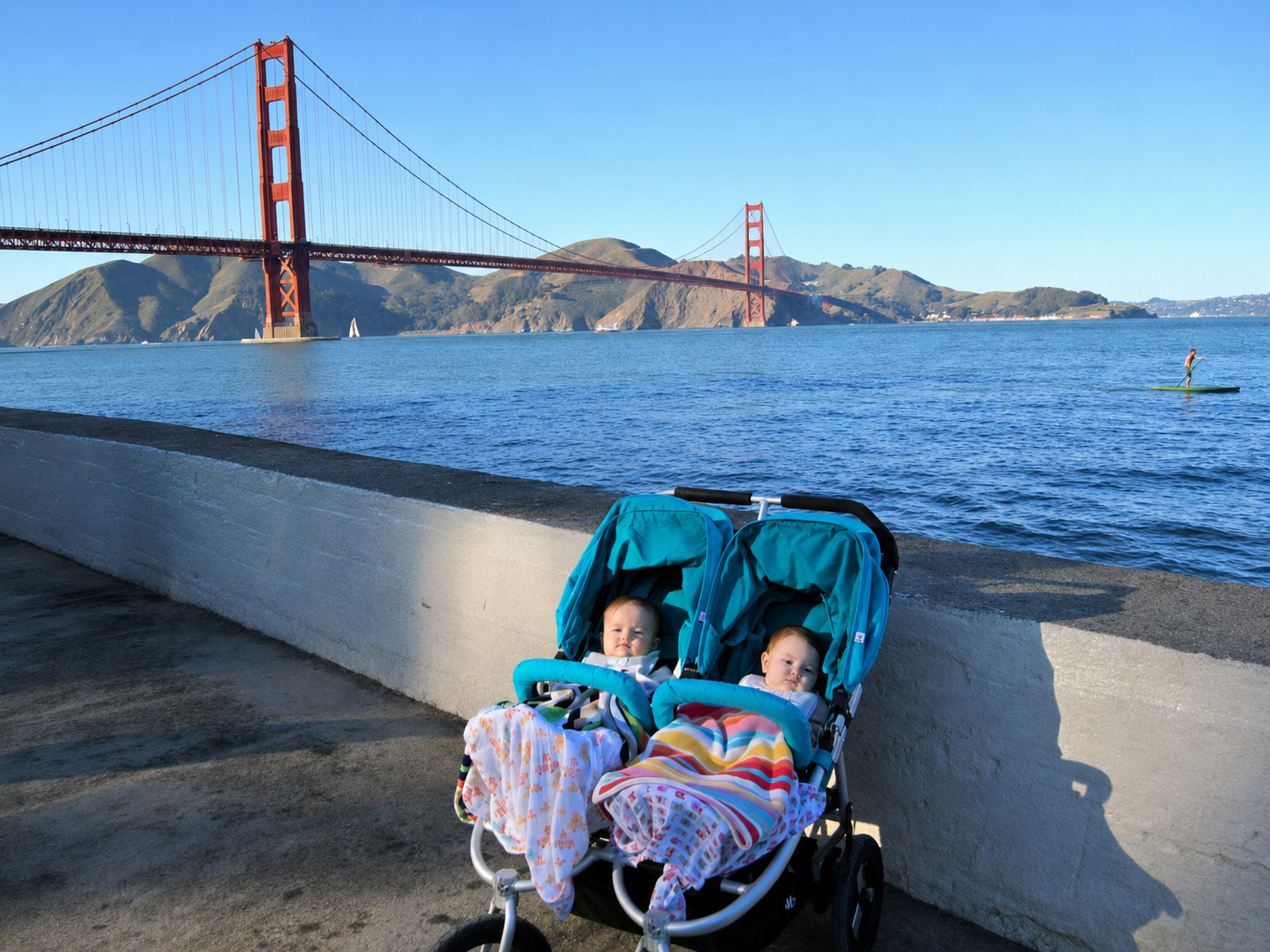
There's a photo somewhere of me standing in our living room surrounded by moving boxes, holding a baby in each arm. Jackson and Harper were seven months old. Almost everything we owned was in cardboard. And I was about to move my brand-new family across the country to start a company.
Looking back, I understand why people gave us that look. You know the one. The tilted head, the careful voice: "Wow. That's... a lot."
It was a lot.
The year everything happened at once
Jackson and Harper were born in March 2014. If you've had twins, you know what those first months are like. If you haven't, imagine the hardest project you've ever run, except the stakeholders never sleep, the requirements change hourly, and you love them more than anything you've ever built.
Most people in that situation batten down the hatches. Stability. Routine. Safety.
By October, we were in San Francisco, and I was starting a company.
I'd love to tell you it was a carefully reasoned decision. The truth is closer to this: I had an idea I couldn't put down, a window I believed wouldn't stay open, and a conviction that if I didn't bet on myself now, "someday" would quietly become "never."
What I remember most from that stretch isn't the pitch decks or the product roadmap. It's the math I kept doing in my head at 2 a.m., holding a bottle in one hand and my phone in the other, toggling between a fussy baby and a fussier cap table. Everyone talks about founder sleep deprivation like a badge of honor. I had the twin-dad version. Nobody gives you a badge for that one. You just get really good at doing everything one-handed.
Family isn't the why. It's the how.
Here's where I'm supposed to write that my kids were my motivation, that I did it all for them. And sure, some of that is true.
But that's not the real lesson, and I think the "I do it for my family" line actually gets the story backwards.
My family wasn't the reason I could take the risk. My family was the infrastructure that made the risk survivable. There's a difference, and it took me years to see it.
No one builds anything alone. Founders say that all the time about their teams, and they mean it. But I learned it at home first. Every investor meeting I took, someone was holding a baby. Every late night at the office was matched by a later night in the nursery that someone else was covering. The company got built because a team of people, most of whom never appeared on the org chart, decided it should exist.
That reshaped how I've led every team since. When someone on my team is carried by people I'll never meet, a spouse, a parent, a friend covering for them at home, I try to remember that I'm not just leading the person in the meeting. I'm borrowing against a whole support system. Leaders who forget that burn through people. Leaders who remember it build teams that last.
Then came Logan
A few years into the journey, our son Logan arrived.
By then I was a different founder than the guy in the moving boxes. The twins-era version of me believed presence was measured in hours, so I tried to be everywhere and was fully present almost nowhere. The version of me that Logan got had learned, slowly and imperfectly, that presence is measured in attention. Twenty focused minutes on the floor with your kid beats three distracted hours in the same room. The same is true in a one-on-one with an employee.
Kids have a way of auditing your priorities in real time. A board meeting can be rescheduled. A first step happens once. I didn't always get the trade-offs right, and I won't pretend otherwise. But the twins, and then Logan, kept dragging my definition of success back to something sturdier than a fundraise announcement: Did the people who count on me, at home and at work, get the best of me or the leftovers?
I still ask myself that question. Some weeks I still don't love the answer. But asking it is the discipline.
What it all taught me
If I compress a decade of building companies and raising kids into what actually transfers, it's this:
Focus isn't about doing less. It's about knowing, in any given moment, what actually matters most, and having the courage to let the rest wait. Twins teach you this fast, because you physically cannot do everything at once. So does a startup.
Support is a strategy, not a soft skill. The people around you determine your ceiling. Choose them well, thank them specifically, and never confuse "I did this" with "we did this."
And the best things in life arrive on inconvenient timelines. Nobody would schedule twins seven months before a company launch. But waiting for the convenient moment is how most dreams die politely in their sleep.
The next verse
Which brings me to now.
Twelve years after those moving boxes, I'm starting again. The new company is called Duet, and the name is not an accident. Everything I've learned, from a nursery with two cribs to a marketing org spanning the globe, points at the same truth: the best work happens beside people, not above them. Duet is that belief, built into software, a place where humans and AI work as genuine teammates to grow companies together.
Jackson and Harper are twelve now. Logan is right behind them. They're growing up in a moment when the tools of creation are more powerful and more accessible than at any point in human history, and I get to spend my days building the kind of teammates they'll one day work alongside.
People ask if I'm nervous about starting over, about the pace of AI, about doing this again at this stage of life. Honestly? Mostly what I feel is the same thing I felt in that living room full of boxes, obsessed over two babies and one enormous bet.
We are so lucky to be alive at a time like this.