I Just Did 9 Months of Marketing Work in 30 Days. I Don't Think Marketing Will Ever Be the Same.
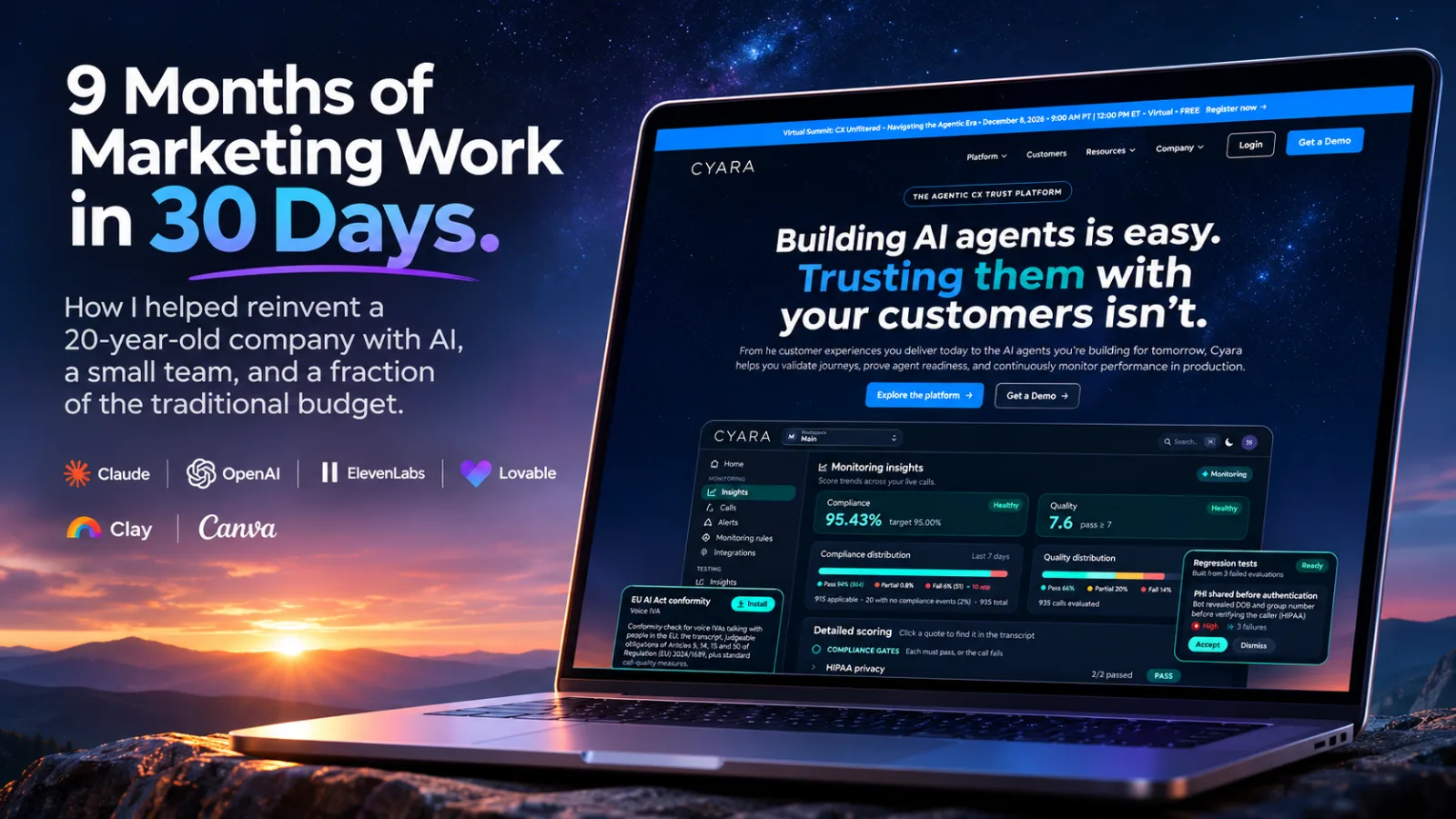
How I helped reinvent a 20-year-old technology company with a small team, a handful of AI tools, and a fraction of the traditional budget.
About 45 days ago, I walked into a new role as CMO of Cyara.
Thirty days later, we had essentially relaunched the company.
New positioning. New brand. New logo. New website. New messaging. New sales presentations. New collateral. New videos. New go-to-market strategy. And a completely different story about where the company fits in a world being rapidly reshaped by AI.
Not a campaign refresh. Not a new coat of paint on the homepage.
A fundamental reinvention of how a 20-year-old technology company presents itself to the market.
I've spent more than two decades building companies, marketing teams, and go-to-market engines. I've founded an agency, built a SaaS startup, helped scale Gainsight from roughly $30 million to $300 million, and worked with some incredibly talented creative and marketing teams along the way.
I know what this kind of transformation typically requires.
Six to nine months. Multiple agencies. Dozens of meetings. Hundreds of thousands of dollars. And enough PowerPoint presentations about the transformation to make you wonder whether the transformation will ever actually happen.
We did most of it in 30 days.
With a small team, a few outside specialists, and a collection of AI tools that cost a tiny fraction of what we would have spent even a couple of years ago.
And somewhere in the middle of it all, I had a realization.
I don't think I'll ever build or lead a marketing organization the same way again.
First, a little context.
Cyara isn't a startup.
It's a 20-year-old enterprise technology company with more than 450 customers, supporting hundreds of millions of customer journeys every year.
For years, the company has helped some of the world's largest enterprises test, monitor, and improve their customer experiences.
But the market is changing.
Contact centers are being rebuilt around AI. Companies are moving beyond traditional chatbots and automated phone menus toward AI agents that can reason, make decisions, take actions, and increasingly represent a brand directly to its customers.
That's a pretty significant shift.
And it creates a fascinating problem.
Companies are racing to deploy AI agents. But who's making sure those agents actually work? That they say the right things? That they don't hallucinate, violate policies, frustrate customers, or completely fall apart under pressure?
Cyara had much of the technology to answer those questions.
What it needed was a new story.
A story that connected two decades of experience assuring customer journeys with the next generation of AI-powered customer experiences.
That's what we set out to build.
We repositioned the company around an Agentic CX Trust Platform, bringing together testing, monitoring, and observability under one story about confidence in every customer interaction.
The underlying idea was simple.
Building AI agents is easy. Trusting them with your customers isn't.
That became the foundation for everything else. <Cite refs={["turn306893search2","turn306893search3"]}/>
The old playbook would have taken nine months.
I know because I've run it.
You hire a brand agency to research the market and develop positioning. You bring in a creative team to explore visual identities. You work with a web agency on information architecture, wireframes, designs, and development.
Then product marketing rewrites the messaging. Sales enablement rebuilds the decks. Demand generation creates campaigns. Someone produces videos. Someone else updates the collateral.
Every workstream has dependencies.
Every dependency has meetings.
Every meeting somehow creates three more meetings.
Eventually, months later, you have a new brand and a very tired marketing team.
To be fair, that process can produce incredible work. I've been part of some of it.
But I started wondering how much of that time was genuinely necessary to produce a great result, and how much was simply the cost of coordinating people, processes, and specialized tools.
Because AI has changed that equation.
Dramatically.
I didn't hire an army. I built one.
When I joined Cyara, I didn't inherit a giant marketing organization with endless capacity.
We had a small team navigating a transition, some talented internal partners, and a lot of work to do.
I also had something I wouldn't have had a few years ago.
An entirely new way to work.
I used Claude as a strategist, researcher, writer, analyst, and execution partner. ChatGPT helped challenge ideas, develop creative concepts, and generate visuals. Claude Design and Canva helped turn those concepts into branded assets. ElevenLabs helped us create professional-quality video voiceovers. Clay supported the data and targeting side of our go-to-market work.
And I experimented with tools like Lovable to move from an idea to a working website experience without spending weeks explaining the idea to someone else.
None of these tools is particularly remarkable in isolation anymore.
What's remarkable is what happens when you connect them.
I could move from researching a market to developing a positioning framework, to designing a website, to building a sales presentation, to creating campaign assets without handing the project off to five different teams.
The distance between an idea and its execution practically disappeared.
And that was the breakthrough.
AI didn't just make the work faster. It eliminated much of the friction between different kinds of work.
I wasn't waiting for a designer to visualize an idea or a developer to make it real. I could build something, evaluate it, change it, and put it in front of the team almost immediately.
Sometimes the first version was terrible.
That's fine.
Because the second version took minutes instead of days.
And the tenth version was often better than what we would have produced after weeks of traditional back-and-forth.
Here's what 30 days actually looked like.
We rebuilt the company's positioning and messaging from the ground up.
We created an entirely new visual identity, including a refreshed logo, color palette, imagery, brand guidelines, and design system.
We rebuilt the website to reflect the new positioning, with new pages, new content, new graphics, and a completely different experience.
We redesigned our sales presentations, including a master deck, first-call presentations, and supporting talk tracks.
We developed new product messaging, datasheets, sales collateral, and enablement materials.
We created new video content, incorporating AI-generated visuals and voiceovers that previously would have required a much more involved production process.
We developed an AI trust maturity framework to help customers better understand their readiness for the agentic era.
And we worked on the less glamorous but equally important things: pipeline models, planning, budgets, reporting, and aligning the marketing strategy with the company's broader growth objectives.
Was every single thing perfect on day 30?
Of course not.
Some assets will evolve. Some messaging will improve. Some campaigns will work, and others won't.
That's marketing.
But we weren't staring at a six-month roadmap anymore.
We had a new foundation for the business, and we were already building on it.
The most important tool wasn't AI. It was experience.
Here's where I think a lot of the conversation about AI and marketing misses the point.
Someone with very little marketing experience can now use AI to create a beautiful website, a polished presentation, or a convincing-looking strategy document.
That doesn't mean it's good marketing.
AI doesn't automatically know which market to pursue, which customer problem matters most, what makes a company genuinely different, or how to turn a compelling story into revenue.
It can give you 50 headlines in 30 seconds.
It can't tell you which one is worth betting the company on without the right context and judgment.
That's where experience becomes incredibly valuable.
I've spent 20-plus years learning what works, what doesn't, how buyers think, how sales teams sell, how categories develop, and how companies grow.
I've made plenty of mistakes along the way.
Those mistakes are suddenly worth a lot more.
Because now I can take that experience and apply it at a speed that simply wasn't possible before.
I can recognize a bad idea faster. Challenge a positioning statement more aggressively. Spot inconsistencies across a dozen assets. Push a creative concept through multiple iterations before lunch.
AI gives me leverage.
Experience tells me where to apply it.
The marketer with 20 years of experience and AI isn't just faster than the marketer with 20 years of experience without it. They're operating with an entirely different set of possibilities.
And I think we're only beginning to understand what that means.
The economics are almost absurd.
Let's talk about money.
A traditional rebrand and go-to-market relaunch of this magnitude could easily cost hundreds of thousands of dollars when you account for agencies, creative production, development, consultants, and internal resources.
Our direct AI tool expenses were under $1,000.
Even when I consider the broader incremental resources involved, we're talking about a fraction of the traditional external spend, likely under $10,000, excluding existing salaries and my own time.
That's not a fully loaded accounting comparison, and I don't want to pretend it is.
We had people involved. We had existing expertise. We worked with Little Taller, our agency partner, to help bring the website into WordPress and prepare it for long-term use. Our internal team and sales engineers reviewed, challenged, refined, and helped deliver the work.
Those contributions mattered enormously.
But the economic difference is still staggering.
More importantly, think about what that means for companies that previously couldn't afford to compete at this level.
A startup with a great product but a limited budget can suddenly build a brand that looks and feels like it belongs alongside much larger competitors.
A midmarket company can modernize its entire go-to-market presence without committing to a yearlong transformation.
And an experienced marketer with a small team can accomplish things that once required an entire department.
That should get every CEO, CMO, and investor's attention.
We didn't stop at the relaunch. We're going bigger.
One of the things I'm most excited about is what we're doing next.
On December 8, we're hosting CX Unfiltered: Navigating the Agentic Era, a major virtual event designed to bring together customer experience leaders and create meaningful demand for the business.
And we brought in Dan Heath as our keynote speaker.
Yes, that Dan Heath.
The bestselling author behind Made to Stick, Switch, and The Power of Moments.
I've admired his work for years, particularly his thinking about the moments that shape how people experience a company, a product, or a relationship.
It's a perfect conversation for where customer experience is heading.
Because as AI agents take over more customer interactions, the moments that build or destroy trust are changing too.
We're treating this as a real production, not another webinar with a couple of talking heads and a slide deck.
The ambition is bigger. The experience is bigger. And the expectations for what marketing should contribute to the business are bigger.
That's the other thing AI has changed.
When you spend less time and money producing the fundamentals, you can invest more energy in the things that actually differentiate your company.
The ideas. The experiences. The relationships. The moments people remember.
That's where I want my marketing team spending its time.
I think the traditional marketing org chart is about to get very uncomfortable.
For years, we've organized marketing around specialized functions.
Brand. Product marketing. Demand generation. Content. Design. Marketing operations. Web. Events.
There's a good reason for that. Each discipline requires expertise.
But increasingly, the boundaries between those disciplines are becoming less relevant to how the work actually gets done.
A strong product marketer can now create the visual assets that bring their messaging to life.
A demand generation leader can build a landing page, develop creative variations, and launch an experiment without waiting on three different teams.
A CMO can go from strategy to a tangible execution in the same afternoon.
That doesn't mean we no longer need specialists.
We absolutely do.
But I think we're going to need fewer handoffs, fewer layers of coordination, and more people who can connect strategy to execution.
The next generation of great marketers won't necessarily be the people who know one function better than anyone else.
They'll be the people who understand how the functions fit together and can use AI to move across them.
People with curiosity, judgment, creativity, business acumen, and the willingness to get their hands dirty.
People who can think like a strategist, create like a designer, analyze like an operator, and understand revenue like a salesperson.
The future belongs to marketers who can both think and build.
And increasingly, I suspect the distinction between those two things will disappear.
There's a catch. Speed can make bad marketing worse, too.
I should probably acknowledge something.
Moving this quickly is not without risk.
AI can produce an astonishing amount of mediocre work if you let it.
It can confidently invent statistics, recycle generic positioning, create beautiful but meaningless designs, and make a company sound exactly like every other company using the same tools.
And because it's so fast, you can create an enormous amount of bad marketing before anyone notices.
That's why I don't think the answer is to automate the entire marketing department and hope for the best.
It's to rethink what humans should be spending their time doing.
I spent a lot of time talking with people, listening to customers, debating positioning with our CEO and leadership team, reviewing creative, challenging claims, and deciding what actually felt right for the company.
The AI did an extraordinary amount of execution.
But the direction, judgment, and accountability stayed with us.
And I think that's the balance we're going to have to get much better at finding.
The goal isn't to remove humans from marketing.
It's to remove the things that keep great marketers from doing great marketing.
I used to think building a great marketing organization meant building a bigger team.
I'm not so sure anymore.
Early in my career, I measured progress partly by what we were able to build.
More people. More capabilities. More campaigns. More production capacity.
And there was a certain satisfaction in that.
But after this experience, I'm starting to think about marketing organizations very differently.
What if the goal isn't to build the largest team you can afford?
What if it's to build the smallest, smartest, most capable team that can accomplish something extraordinary?
A team where every person has the tools to multiply their impact.
Where specialists still matter, but collaboration doesn't require endless handoffs.
Where leaders spend less time managing production queues and more time thinking about customers, markets, differentiation, and growth.
And where the constraint is no longer how quickly you can produce something, but how good your ideas actually are.
That's a very different world.
And frankly, I find it pretty exciting.
Thirty days changed my perspective on the next 20 years.
I don't want this to come across as some kind of victory lap.
We're just getting started at Cyara.
A new brand doesn't automatically create pipeline. A beautiful website doesn't close deals. A great virtual event doesn't guarantee revenue.
We still have to prove that the work translates into meaningful business outcomes.
And that's the part I'm most interested in.
But I also don't want to minimize what just happened.
We accomplished something in 30 days that I genuinely believe would have taken six to nine months not very long ago.
We did it with a small group of talented people, a lot of collaboration, a willingness to experiment, and AI tools that are accessible to almost anyone.
And I had more fun doing it than I've had in a long time.
Not because AI did the work for me.
Because it let me do more of the work I actually love.
Building. Creating. Thinking. Challenging assumptions. Connecting ideas. Bringing something new into the world.
I've spent most of my career believing that great marketing is a combination of art, science, storytelling, and execution.
I still believe that.
I just think the relationship between those things has changed forever.
AI has made execution dramatically more accessible. Which means judgment, creativity, experience, and humanity are about to become dramatically more valuable.
The next generation of marketing leaders won't be defined by how many people they manage, how big their budgets are, or how many agencies they can afford.
They'll be defined by what they can imagine, how quickly they can turn it into reality, and whether it actually makes a difference.
Thirty days ago, that felt like a theory.
Now I've lived it.
And I don't think I'm going back.
— Scott