There is a particular kind of energy that comes from building something of your own.
It’s hard to explain unless you’ve felt it. An idea follows you into the shower. A customer conversation rearranges your entire roadmap. You wake up thinking about the thing and, if you fall asleep, you’re still turning it over in your head.
It can be exhausting. It can be all-consuming. It can be wildly impractical.
And I missed it more than I realized.
I started my first two companies without really knowing how to start a company.
I knew how to sell. I knew marketing. I could write copy, design a deck, build a website, and make an idea feel real enough that other people might believe in it too. But there was an enormous amount I didn’t know about capital, hiring, product, leadership, scale, or how to carry the weight of other people trusting you with their careers.
So I made mistakes. A lot of them.
Both companies had real success. IDS grew into a meaningful business. Allbound helped create a category, served great customers, and eventually reached a successful exit. I know I should be proud of that, and sometimes I am.
But if I’m honest, I’ve also carried a quieter feeling with me: they could have been more.
I could have been a better leader. I could have made better decisions. I could have moved faster in some moments and slowed down in others. There were people I worried I had let down. And somewhere along the way, I burned myself out trying to compensate for everything I didn’t know by simply working harder.
That is one of the traps of entrepreneurship when you’re young. The work gives you so much energy that you assume it can’t also be taking something from you.
I loved waking up with a reason to run toward the day. I loved caring so much that I never wanted to put the work down. But once you get married, have kids, and become responsible for lives beyond your own, “never putting it down” stops sounding quite so romantic.
Passion is powerful. Unmanaged, it can also consume everything around it.
Learning to build someone else’s thing
After I left Allbound, people told me I’d probably never be able to have a job again.
For a while, I wondered if they were right.
When I joined Gainsight, I struggled at first. The work was interesting. The company was special. But it wasn’t mine. It wasn’t an idea I had sketched out in my living room at 3 a.m. in PowerPoint and Photoshop. I hadn’t named it. I hadn’t imagined it into existence. I had been invited into someone else’s story.
It took me some time to understand that this wasn’t a limitation. It was the opportunity.
At Gainsight, I got to become a student again.
I learned from people who were exceptional at things I had mostly taught myself. I watched leaders build not just a software company but an entire category and community. When Vista acquired us, I got a front-row education in how a great private equity firm thinks about operating and scale. As we acquired other companies, I learned alongside CEOs and founders who had taken entirely different paths to the same table.
I sat in offsites with people whose talent intimidated me. I took on roles I wasn’t sure I deserved. Somehow, over time, I earned them.
That is still difficult for me to say without immediately qualifying it, so I’ll let the sentence stand.
I spent years absorbing everything I could: how to lead at a different scale, how to build systems instead of heroics, how to surround yourself with people who are better than you, and how much more a company can become when it isn’t limited by one person’s experience or endurance.
I became deeply invested in the work and the people. But even during those years, a question kept running quietly in the background:
Will I ever build something of my own again?
I wasn’t certain the answer would be yes. That scared me more than I usually admitted.
Then AI changed the question
When generative AI arrived, my first reaction was probably similar to a lot of people’s.
I thought it was incredible.
I also wondered if it was coming for my job.
If a machine could write, analyze, design, research, strategize, and create, what would happen to people like me? What would experience be worth? Would the skills I had spent decades accumulating suddenly become less relevant?
But the more I used AI, the more the question changed.
It stopped being, “What is this going to take away from me?”
It became, “What will this finally allow me to build?”
I started small and close to home.
I built a tool for my daughter to plan daily outfits and share them with her friends. I built a baseball card trading site for my son and his little business. For my youngest, who loves airplanes, I quickly created a site that helps him understand which planes are passing overhead.
None of these were world-changing products. That was the point.
They were ideas that once would have died in the space between “Wouldn’t it be cool if…” and the time, money, and technical resources required to make them real. With AI, that space suddenly became very small.
I could have an idea and start making it tangible that night. I could learn by building. I could make something useful for someone I loved before the spark disappeared.
And every time I did, I felt a familiar current switching back on.
A different way to start again
Now I’m using that same leverage to build Duet.
The experience is almost disorienting.
I can listen to someone describe a problem in the morning and begin applying what I learned to the product that afternoon. I can move from idea to prototype to feedback at a speed that would have been impossible the last time I started a software company.
I’m building something more sophisticated than the first version of Allbound in a fraction of the time and with a fraction of the budget.
That doesn’t mean it’s easy. AI does not remove uncertainty. It doesn’t make the decisions for you, create conviction, talk to customers, earn trust, or tell you which of its very plausible answers is actually right.
It does something more interesting: it gives experience leverage.
The tools are dramatically better, but I’m different too.
I’m bringing the mistakes from my first two companies. The lessons from Gainsight. The operators and founders I learned beside. The teams I had the privilege to lead. The perspective that comes from raising three kids while trying, not always successfully, to be present for the life happening outside the company.
The younger version of me often answered uncertainty with more hours. This time I want to answer it with better questions, tighter feedback loops, stronger partnerships, and more trust in other people.
The goal isn’t to care less. It’s to care more wisely.
The hands we put it in
One of the most powerful and frightening things about AI is that so much depends on whose hands it is in.
In the wrong hands, it can strip the humanity out of the work. It can flood every channel with more content, more outreach, more noise, and less meaning. It can turn customers into data points and people into costs to be removed.
But in thoughtful hands, AI can help people create things they never had the resources, permission, or technical ability to create before. It can give a founder a team before there is a team. It can let a parent turn a child’s passing idea into something real. It can give an experienced operator the freedom to begin again without rebuilding every piece of infrastructure from scratch.
I don’t believe the companies that win this era will be the ones that simply use the most AI.
I think they’ll be the ones that pair it with the most humanity.
They’ll use AI for speed, scale, synthesis, and execution, then rely on people for taste, judgment, empathy, accountability, and the courage to care about the outcome. They’ll create better customer experiences because technology gives their people more capacity to understand and serve, not just more capacity to produce.
That is the idea inside Duet. Not human or AI. Human with AI.
It’s also the idea that has been hiding in my work all along. The promise of Allbound was “never sell alone.” Now I’m building a company whose name is a partnership.
Apparently I’ve been circling the same truth for most of my career.
The feeling is back
So here I am again.
I’m building a company. I’m launching a website. I’m writing about my life and work in public, which may be the most uncomfortable item on that list. I’m getting ready to share a product that has lived in my head for a long time and is becoming more real every day.
And I feel that rush again.
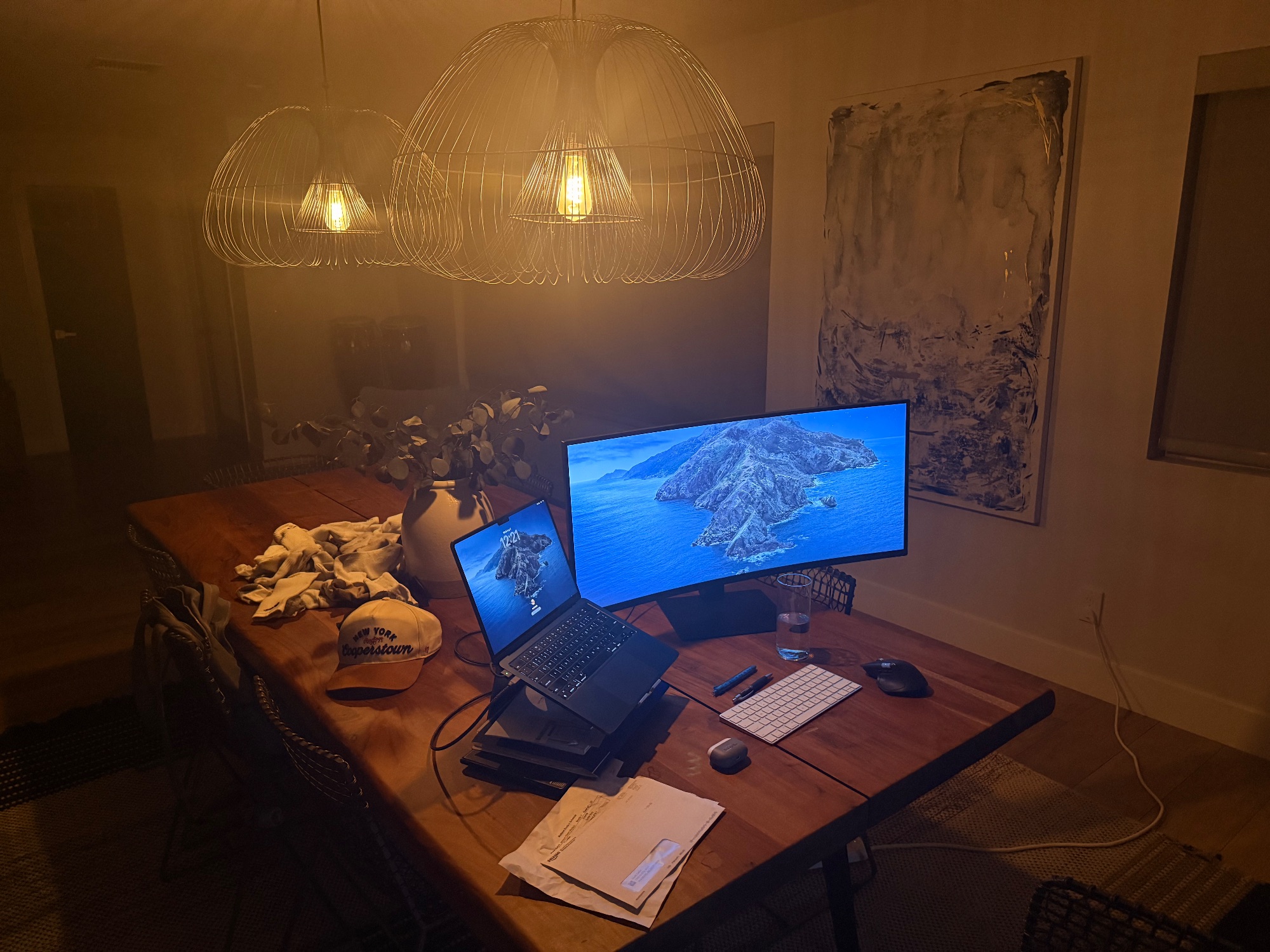
The ideas that won’t wait. The customer conversations I keep replaying. The urge to open the laptop after everyone else is asleep because I can suddenly see how something should work.
I know this feeling can be dangerous. I also know how lucky I am to feel it again.
This time, I don’t want to prove that I can do everything myself. I’ve already learned where that road leads.
I want to see what becomes possible when twenty years of scar tissue meets a completely new set of tools, and when ambition is paired with enough perspective to know what should never be sacrificed to it.
Same fire. Better tools. More wisdom.
And, fittingly, I’m not building alone.