Patience is NOT a big strength of mine.
I'm an entrepreneur at heart. I like building things, solving problems and moving quickly. Give me a choice between another planning meeting and actually doing something, and historically I haven't had to think very hard about which one I'd choose.
But I've also spent enough time inside companies that scaled well (and enough time inside companies that struggled to) to realize I had some of this wrong.
Process isn't the opposite of speed.
The right process is what makes speed possible.
And there may be no better example than the way companies plan their year.
We're heading into that season right now. Somewhere inside thousands of companies, a CEO or CFO is looking at the calendar and realizing the new fiscal year isn't nearly as far away as it seemed a few months ago.
There are numbers to build. Budgets to allocate. Headcount to approve. Quotas to set. Product priorities to reconcile. Marketing plans to develop. Kickoffs to schedule.
Suddenly everyone needs to "get aligned."
So calendars fill up, spreadsheets start flying around, departments disappear into their own planning processes, and someone schedules a leadership offsite with the expectation that two days in a conference room will somehow make all of it come together.
I've been part of plenty of those.
I've probably created a few of them.
And what I've learned is that if you're trying to figure out the plan at your company kickoff, you're already too late.
A kickoff isn't a planning meeting
A kickoff should be the moment the company understands the plan, believes in it and knows what role each person plays in making it happen.
It shouldn't be the moment the leadership team is still figuring it out.
Yet that's essentially what happens at a lot of companies.
Finance builds a revenue target. Sales builds a capacity model. Marketing builds a pipeline plan. Customer Success builds an expansion target. Product builds a roadmap. People builds a headcount plan.
Each function may do perfectly good work, but they're often solving different versions of the same puzzle without seeing the whole board.
Then everyone gets together and discovers that the pieces don't quite fit.
Sales needs 15 reps to hit the bookings number, but Finance budgeted for 11. Marketing's pipeline target assumes a conversion rate Sales doesn't believe is realistic. Customer Success has an expansion goal that isn't reflected in the account coverage model. Product's roadmap doesn't line up with the markets GTM is planning to pursue. Hiring dates don't match ramp assumptions. The budget was built from one set of assumptions and the operating plan from another.
Now you're not planning.
You're negotiating.
And you're doing it with a clock running.
The best planning system I've used was surprisingly simple
One of the things I loved at Gainsight was the OPSP.
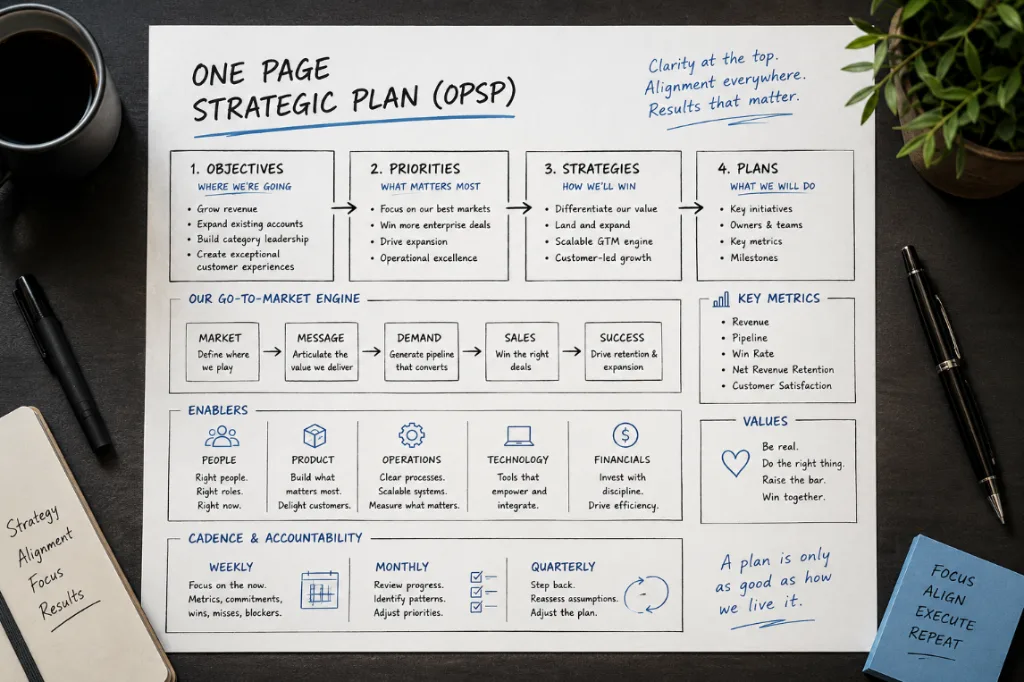
An OPSP is a One Page Strategic Plan (I've also seen it defined as Objectives, Priorities, Strategies and Plans), and it became a common language for how we thought about where we were going and how the work connected.
The concept wasn't complicated.
What are we trying to accomplish?
What matters most?
How are we going to do it?
What specifically needs to happen?
At the company level, those choices could then cascade into functional OPSPs for Sales, Marketing, Customer Success, Product and the rest of the organization. Instead of every department inventing its own definition of success, there was a visible connection between what the company said mattered and what teams were actually spending their time doing.
I saw how powerful that could be. But I've also learned something since then:
An OPSP isn't an operating system. It's an artifact produced by one.
That's an important distinction.
You can fill out the world's most beautiful strategy template and still have a company that isn't aligned.
The real work happens before and after the document.
The plan has to start with the math
I've been helping a company work through this process recently, and one of the first things we did was resist the temptation to jump straight into departmental planning.
Instead, we started building the system backward from the outcome.
If the company wants to generate a certain amount of revenue, where does it actually come from?
How much comes from new customers versus existing customers? What does that imply for bookings? What level of retention and expansion is required? How much pipeline has to be created? What conversion rates are we assuming? How many opportunities does that require? How much selling capacity do we need? When do those people need to be hired to become productive in time?
Those questions quickly begin connecting parts of the company that are too often planned separately.
The revenue goal creates a bookings requirement. The bookings requirement creates pipeline requirements. Pipeline and conversion assumptions influence marketing and sales capacity. Expansion assumptions connect Customer Success and Sales. Product priorities influence which markets and use cases GTM can credibly pursue. All of it eventually flows into headcount and budget.
Change one assumption and something else changes with it.
That's why I increasingly think of annual planning less as building a plan and more as building a model of the business.
Before you decide what everyone should do, you need a shared understanding of how the company believes growth is actually going to happen.
Then strategy gets to enter the conversation
The spreadsheet isn't the strategy either.
It tells you what needs to be true. It doesn't tell you how you're going to make it true.
If the model says Marketing needs to generate significantly more qualified pipeline next year, "generate more pipeline" isn't a marketing strategy.
Where will it come from?
Which segments matter most?
Which accounts?
Which buyers?
What are we going to say to them?
What programs deserve investment?
Where are we already seeing evidence that something works?
What are we going to stop doing?
The same questions apply across the organization.
If expansion is critical to the model, what specifically changes about the customer journey? If a new product is expected to contribute materially to growth, when does it need to launch and what has to happen before and after that launch? If enterprise sales productivity needs to improve, is the answer more sellers, better enablement, a different coverage model, better qualification—or something else entirely?
This is where planning becomes strategy rather than budgeting.
And it's also where the conversations get harder, because real strategy forces choices.
The company plan should cascade, not fragment
Once those choices are made at the company level, departments can build their own plans.
That's where I've seen the OPSP work beautifully.
The company's objectives become the context for the department's objectives. The company's priorities influence the department's priorities. Strategies become specific enough that teams understand what they're responsible for, and plans become measurable enough that everyone knows whether they're actually happening.
You can trace the work upward.
A marketer should be able to understand how the program they're running connects to a marketing priority, how that priority connects to a company strategy, and ultimately how it contributes to an objective the business has agreed matters.
That sounds obvious.
It's surprisingly rare.
Without that connection, organizations slowly accumulate work. Every initiative has an owner and every owner can explain why their initiative matters, but nobody is regularly asking whether all those things collectively represent the best use of the company's finite resources.
That's how you end up with a company full of incredibly busy people wondering why it isn't moving faster.
And then January 1 happens (or February 1)
This may be the biggest mistake I've seen companies make.
They spend months building the annual plan, present it beautifully at kickoff, everyone gets excited...
…and then they go back to work.
The deck gets filed away. The OPSP lives in a folder somewhere. The priorities remain on a slide until someone pulls it up three months later and realizes half the company is now working on things that weren't on it.
A plan that gets reviewed once a year isn't an operating plan.
It's a time capsule.
The operating cadence around the plan matters just as much as the plan itself.
Weekly reviews should help teams understand what's happening right now: the critical metrics, commitments, wins, misses and blockers that require action.
Monthly reviews should zoom out enough to identify patterns. Are we creating the pipeline we expected? Is sales productivity improving? Are customers expanding? Are product milestones holding? Are hiring and spending tracking against the assumptions we made?
Quarterly reviews should go further still. What did we believe three months ago? What have we learned since? Which assumptions were wrong? What has changed in the market? Which priorities deserve more resources, which need to change, and which should stop altogether?
Because the point of an operating plan isn't to predict the future perfectly.
You can't.
The point is to create a shared framework for recognizing when reality is different from the plan and deciding what you're going to do about it.
Accountability doesn't have to mean bureaucracy
This is probably the part I've had to unlearn most.
For a long time, words like cadence, process, governance and accountability sounded suspiciously like things that happened at companies that had gotten too big.
I wanted fewer meetings, fewer spreadsheets and fewer processes.
I still do.
But I've realized the choice isn't between process and no process.
It's between intentional process and accidental process.
Without an operating cadence, meetings don't disappear. You just end up having more emergency ones.
Without clear metrics, people don't stop measuring things. They build their own dashboards.
Without explicit priorities, teams don't magically focus. Everyone makes their own decisions about what's important.
Without accountability, work doesn't become more entrepreneurial. It becomes harder to understand why things aren't getting done.
The goal isn't more process.
It's enough structure that people can move quickly without constantly having to rediscover where they're going.
I've learned to appreciate the boring stuff
Maybe that's another thing that changes with experience.
Earlier in my career, I was fascinated by the visible parts of building companies: the product, the brand, the launch, the campaign, the big idea.
I still love all of those things.
But I've also become fascinated by the machinery underneath them.
The P&L as a work of art.
How does a company turn an ambition into a number, the number into a strategy, the strategy into priorities, the priorities into departmental plans, and those plans into thousands of decisions made by people every week?
How does leadership know when something isn't working?
How quickly can the company learn?
How does everyone know what matters?
How do you create accountability without killing creativity?
Those things aren't particularly sexy. Nobody posts a photo on LinkedIn celebrating an exceptionally well-run monthly business review.
But after watching enough companies succeed and struggle, I'm increasingly convinced that this is where a huge amount of company-building actually happens.
A great kickoff can inspire a company for a few days.
A great operating system can align it for an entire year.
And if you're waiting until kickoff to build one, you're already too late.
Want the template?
I've taken the annual planning and operating cadence I've been using with leadership teams and turned it into a practical template covering the revenue model, company and departmental planning, headcount, product and GTM dependencies, kickoff workback, and the weekly, monthly and quarterly cadence that keeps the plan alive throughout the year.
I'm making it available for anyone who wants to use it, change it or steal whatever parts are helpful. Just email me at scott@letsduet.ai and I'll send you the link.
Because the goal isn't to create more process.
It's to spend less of the year wondering why the plan and reality stopped looking anything alike.